Frankenstein and Philosophy by Michaud Nicolas
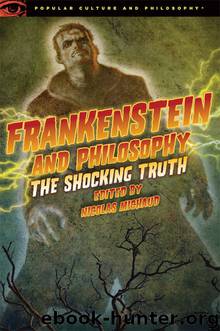
Author:Michaud, Nicolas [Michaud, Nicolas]
Language: eng
Format: epub, mobi
ISBN: 9780812698428
Publisher: Open Court
So What of the Monster?
After listening to the monster’s testimony, we have to conclude that the monster is in some sense a person. At this point it may be helpful to unpack and spell out what exactly is meant by the psychological criterion. Though there is no consensus on this issue a fruitful attempt of spelling out what goes into the psychological criterion is:
1.Consciousness (of objects and events external or internal to the being), and in particular the capacity to feel pain
2.Reasoning (the developed capacity to solve new and relatively complex problems)
3.Self-motivated activity (activity which is relatively independent of either genetic or direct external control)
4.The capacity to communicate, by whatever means, messages of an indefinite variety of types, that is, not just with an indefinite number of possible contents, but on indefinitely many possible topics
5.The presence of self-concepts, and self-awareness, either individual or racial, or both.
Under these conditions, it seems as if we should accept the monster as a person with his own (possibly new) identity. Arguably, the monster gains consciousness from the moment Victor Frankenstein “infused a spark of life into a lifeless thing.” The monster then proceeds to develop his reasoning faculties as well as his capacity to communicate during his time with the cottagers.
Although it’s very briefly outlined, the monster definitely has self-awareness as he makes constant comparisons between what he describes as the “perfect forms” of the cottagers and his disfigured self. Now self-motivated, as defined above, might be interpreted as some degree of freewill, which is a contentious subject in philosophical circles to say the least. Without committing myself to saying whether the monster has freewill, I’ll simply say that the monster has some appreciable amount of what we can call self-motivated activity. So it looks as if the monster can be considered to have his own identity, despite the amnesia problem. As to when exactly he attained-personhood, it can only have been at some point in his hovel.
Overall, the monster’s identity seems rooted in both his psychological contents (his memories and thoughts) and his physical makeup. By now it does look as if the monster is a new instance of a person, at least not identical to whomever owned the body parts at some previous time. The monster starts his identity in Victor’s lab and doesn’t share a history with any of his previous body parts. But at the same time I guess it’s important to recognize the role the physical body plays in the monster’s identity since it is at least necessary for him to build an identity in the first place. After all, what is Victor infusing life into if not a body, regardless of how gruesome it may be? But again, this casts the body as secondary to what is truly important to identity, as we saw how the monster came to build one for himself despite being given an improvised body, really a very crappy hardware system upon which to load a software.
While this may be all well and good
Download
Frankenstein and Philosophy by Michaud Nicolas.mobi
This site does not store any files on its server. We only index and link to content provided by other sites. Please contact the content providers to delete copyright contents if any and email us, we'll remove relevant links or contents immediately.
| Anthropology | Archaeology |
| Philosophy | Politics & Government |
| Social Sciences | Sociology |
| Women's Studies |
The remains of the day by Kazuo Ishiguro(9004)
Tools of Titans by Timothy Ferriss(8403)
Giovanni's Room by James Baldwin(7352)
The Black Swan by Nassim Nicholas Taleb(7137)
Inner Engineering: A Yogi's Guide to Joy by Sadhguru(6799)
The Way of Zen by Alan W. Watts(6621)
The Power of Now: A Guide to Spiritual Enlightenment by Eckhart Tolle(5790)
Asking the Right Questions: A Guide to Critical Thinking by M. Neil Browne & Stuart M. Keeley(5779)
The Six Wives Of Henry VIII (WOMEN IN HISTORY) by Fraser Antonia(5519)
Astrophysics for People in a Hurry by Neil DeGrasse Tyson(5196)
Housekeeping by Marilynne Robinson(4455)
12 Rules for Life by Jordan B. Peterson(4312)
Ikigai by Héctor García & Francesc Miralles(4279)
Double Down (Diary of a Wimpy Kid Book 11) by Jeff Kinney(4278)
The Ethical Slut by Janet W. Hardy(4262)
Skin in the Game by Nassim Nicholas Taleb(4257)
The Art of Happiness by The Dalai Lama(4133)
Skin in the Game: Hidden Asymmetries in Daily Life by Nassim Nicholas Taleb(4012)
Walking by Henry David Thoreau(3968)
